


Criteria for Choosing Industrial Asset Management Software
In the complex ecosystem of modern critical infrastructure, profitability depends not only on production, but also on how efficiently physical capital is managed. Asset Management has evolved from a support function into the core of operational stability. For organizations that operate complex assets, implementing asset management software is a decision that directly affects financial analysis and long-term sustainability.
The objective of a robust Enterprise Asset Management (EAM) system is to provide a 360° view that helps optimize the asset lifecycle. In this guide, we break down the technical and strategic criteria for selecting the right tool.
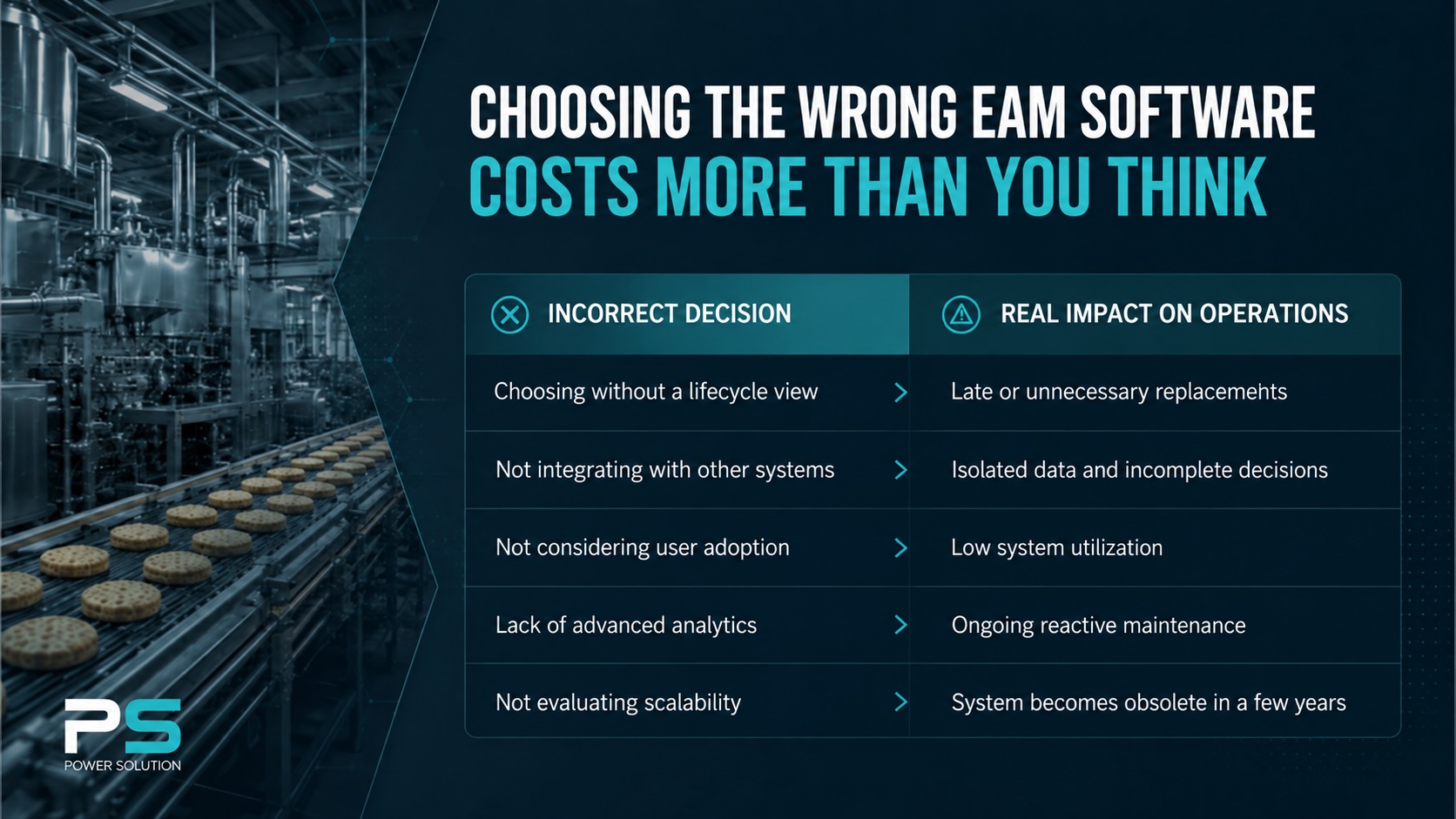
1. The regulatory framework and a comprehensive lifecycle view
The first selection criterion is the tool’s ability to support international regulatory compliance. The ISO 55000 standard should serve as the guide for any enterprise asset management strategy.
Lifecycle management as the central focus
A powerful EAM software solution should not be limited to recording failures. It must address the entire lifecycle management process, from engineering planning through decommissioning. A centralized inventory allows every area, from operations to finance, to work from a “single source of truth,” significantly improving strategic decision-making.
When technical analysis is combined with a financial perspective, asset replacement planning is no longer based on guesswork, but on real performance and degradation data.
2. Technological evolution: AI, IoT and digitalization
In the era of Industry 4.0, the selected software must be prepared for large-scale data analytics. Integration with the Internet of Things (IoT) allows machines to “communicate” directly with the system.
Advanced monitoring and maintenance
By implementing artificial intelligence and big data techniques, companies can move from a reactive model toward predictive maintenance. This is possible thanks to:
- Real-time monitoring: Capturing critical variables such as temperature and vibration.
- Condition monitoring: Identifying anomalies before a failure occurs.
- Predictive analytics: Using algorithms to estimate mean time between failures (MTBF).
The use of artificial intelligence makes it possible to perform usage pattern analysis that improves workflows and reduces unplanned downtime.
3. Usability, mobility and the human factor
Technically perfect software is useless if field technicians do not adopt it. For this reason, process automation and ease of use are essential to meeting user requirements.
Field tools and connectivity
The solution should support mobile devices so operators can manage work orders in situ. The use of barcodes for rapid equipment identification ensures accurate asset traceability and precise movement tracking in real time.
In addition, modern asset monitoring platforms should enable digital asset management (manuals, drawings, diagrams) accessible from anywhere, helping preserve and share the practical knowledge of experienced employees.
4. Operational integration: ERP, HR and supply chain
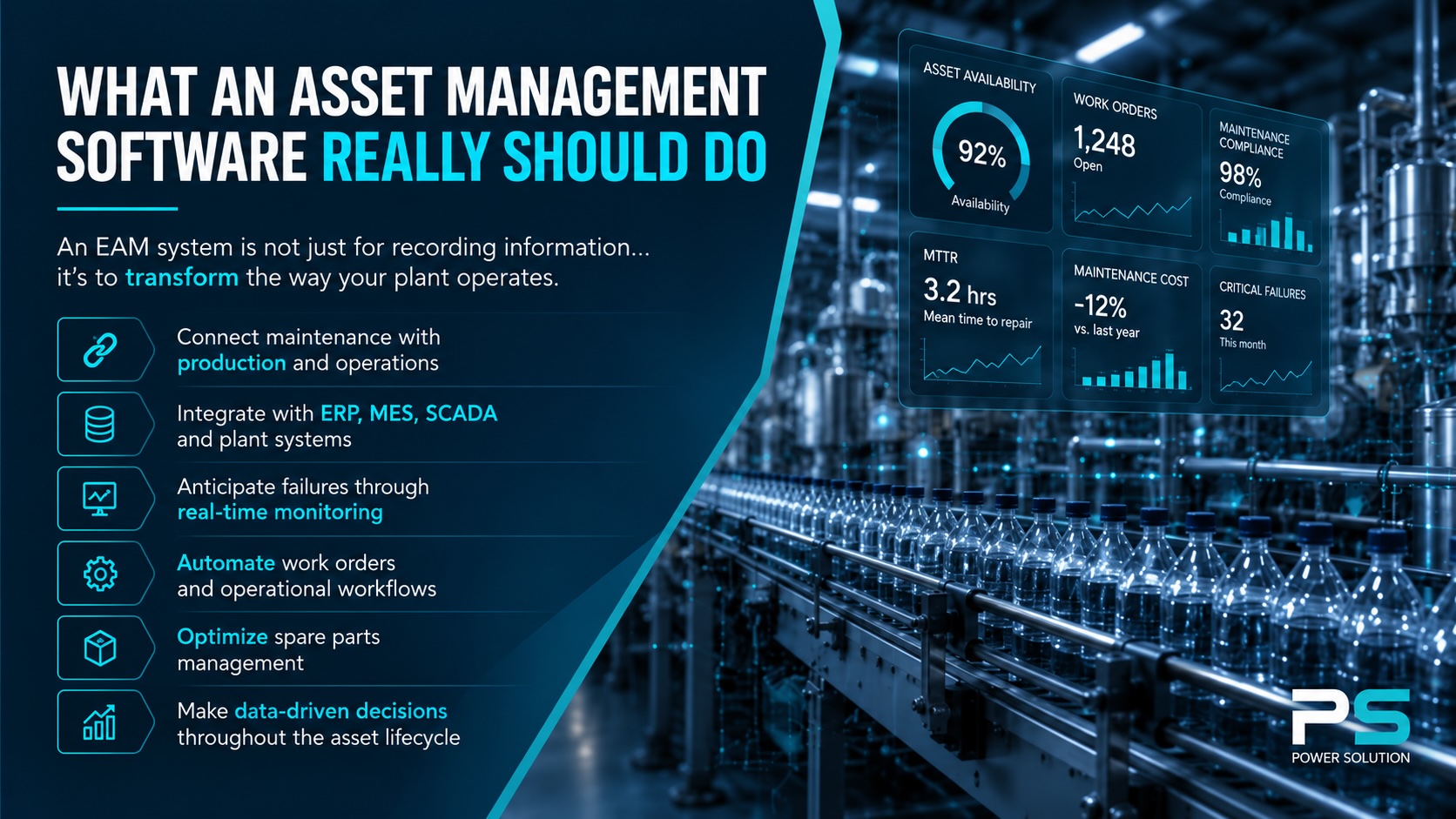
Asset management does not operate in a silo. It requires integration with other systems, especially the corporate ERP. Straightforward integration between EAM software and the rest of the enterprise suite makes it possible to:
- Spare parts management: Ensure the required stock is available without unnecessary costs.
- Human Resources: Verify that assigned personnel have the certifications required to comply with occupational health and safety regulations.
- Project management: Coordinate complex plant shutdowns involving multiple external contractors.
Leading systems such as IBM Maximo Application Suite offer advanced application lifecycle management capabilities, allowing the tool to evolve alongside technology.
5. Asset control and strategic maintenance
To maximize return on investment, it is essential to distinguish between active management (performance optimization) and passive management (basic compliance). Effective asset control requires a reliability-centered maintenance (RCM) approach.
Work order management and reliability
Automated work order management ensures that preventive maintenance is carried out as scheduled. This changes maintenance departments, traditionally viewed as cost centers, into value-generating units through asset performance analysis.
Asset control is not only physical; it also includes digital tracking and control of the digital assets associated with each machine. This greatly facilitates internal audits and ensures the company is always prepared for external regulatory compliance inspections.
6. Scalability and the future of asset management
When evaluating asset management software, asset managers must consider scalability. A cloud-based system (SaaS) offers the flexibility needed to grow without major hardware investments.
Automation and specialization
Automation of routine tasks frees qualified personnel to focus on critical analysis. Look for specialized tools that can map relationships between assets, making it possible to understand how the failure of a minor component affects the entire production line.
Whether you need large-scale infrastructure management or more localized facility management tools, asset management software should be at the heart of your operational strategy.
The value of total control
In conclusion, choosing EAM software requires a balance between technical power and operational simplicity. Success lies in achieving a centralized inventory that supports a reliability-centered maintenance strategy.
Implementing IBM Maximo Application Suite or similar platforms enables real-time monitoring that turns asset management into a competitive advantage. By managing the asset lifecycle from acquisition to final disposal, companies not only protect their capital, but also ensure data-driven decision-making that supports the lifecycle of the entire organization.
Investing in effective lifecycle management and robust asset control is ultimately an investment in the resilience and future of industry. With the support of artificial intelligence and predictive maintenance, the asset lifecycle is extended, costs are reduced, and asset control becomes comprehensive.
Make sure your Asset Management software provides a centralized inventory, supports preventive maintenance, and strengthens industrial asset management across your organization. The right EAM software is a key tool for plant managers seeking excellence in asset lifecycle management. Contact a specialist advisor.