


How Can Industrial Asset Management Help Prevent Unexpected Downtime in Production Facilities?
Major crises in a production plant are almost never spontaneous events; they are usually the outcome of an invisible accumulation of omissions. It all starts with details that seem minor: an outdated technical datasheet, that spare part no one can find, or the suspicious pattern of a machine that always fails at the same point. These are not merely operational oversights, but cracks in poor Industrial Asset Management.
The danger of operational blindness
Operating in the dark, without accurate data on the actual condition of machinery, is like playing Russian roulette with productivity. The risk is not only that something breaks down, but that the company loses its strategic direction. Without visibility, it is impossible to:
- Prioritize the use of limited resources.
- Plan interventions before damage becomes irreversible.
- Decide when it makes more sense to modernize equipment rather than keep repairing it.
A plant without control over its assets may continue operating, but it does so under a false sense of security, becoming more vulnerable with every shift.
From reaction to strategy
True efficiency is not measured by how quickly a technical fire is put out, but by the strength of the system designed to prevent the fire from starting in the first place. Implementing a robust asset management strategy means turning information into foresight. It is not just about repairing machines; it is about seeing ahead, deciding with data, and acting with purpose.
The real cause of many unplanned shutdowns
One of the most common mistakes in industrial environments is assuming that an unexpected shutdown is only a maintenance problem. It is not. In most cases, it is the final consequence of a chain of decisions poorly supported by incomplete information.
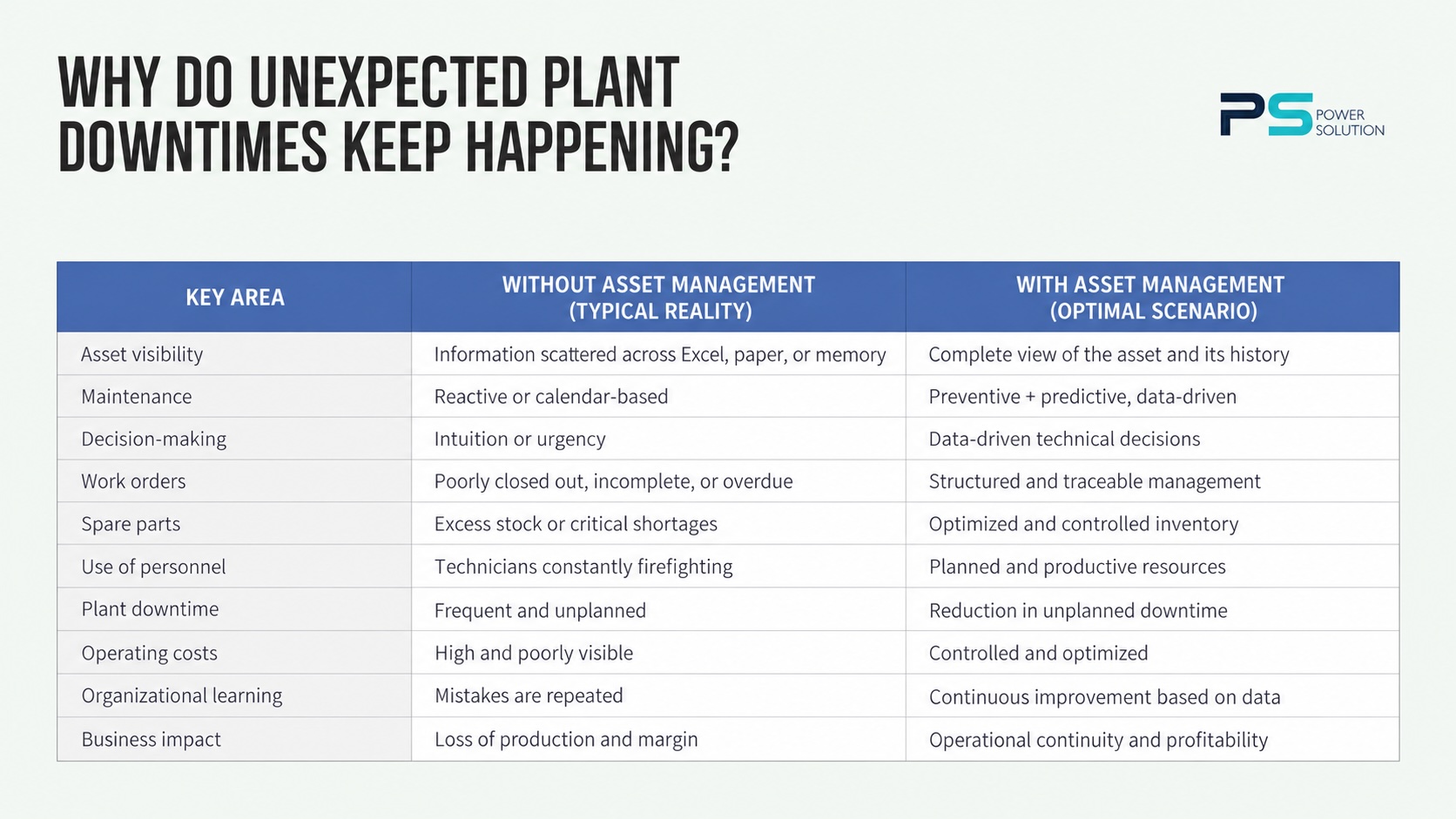
When a plant manages its assets with Excel, partial records, knowledge scattered among technicians, and poorly integrated processes, what it is really doing is operating blindly. It may have discipline, it may have committed personnel, and it may even have robust ERP systems for administrative or financial matters. But if it does not have real traceability of equipment behavior, it still does not have control.
This leads to poor decisions such as:
- buying spare parts that were not needed while not having the ones that were truly critical
- servicing assets according to a calendar even when they do not require it
- delaying action on equipment that was already showing signs of degradation
- failing to distinguish between repairing, replacing, or modernizing
- assigning technicians and resources without solid prioritization
- repeating recurring failures because there is no structured history
An unexpected shutdown, therefore, does not come out of nowhere. It is the visible consequence of poorly managed invisible processes. And that hidden management usually gets worse when there is no true lifecycle tracking or formal Asset Management approach supported by technology tools designed for industrial environments.
In a production plant, an asset is not just a machine
In sectors where the business depends on machines and people operating in sync, a productive asset is not simply another item in inventory. It is a direct component of profitability.
A pump, conveyor belt, filling machine, boiler, screw compressor, CIP cleaning system, or packaging line affects production, quality, energy, logistics, compliance, and customer service. If one of these critical pieces of equipment fails, the result is not just a technical intervention. The entire operation is affected.
That is why Industrial Asset Management should not be understood as an administrative practice. It should be understood as a strategic function for protecting operational continuity.
In practice, the plants that are best at avoiding shutdowns are not necessarily the ones that spend the most on maintenance. They are the ones that best understand which assets are critical, how they are evolving, what their history is, what resources they consume, and what impact their failure would have. This is where asset tracking, understanding the asset lifecycle, and accurately reading operating conditions make the difference. When this does not exist, industrial maintenance stops being a driver of reliability and becomes a source of uncertainty.
The hidden cost of poor asset management
Poor Asset Management does not only increase the frequency of failures. It also multiplies the hidden costs surrounding every unplanned shutdown.
One of these is excess energy cost. When an asset begins to deteriorate due to friction, wear, or misalignment, its consumption often increases before it fails. If no one monitors that progression, the plant continues paying more for energy without realizing that a problem is already developing. This is where practices such as vibration analysis, industrial thermometry, the use of smart sensors and IoT sensors, as well as certain remote monitoring systems come into play, allowing deviations to be detected before the asset becomes a source of loss.
Another hidden cost is found in the spare-parts warehouse. Many organizations tie up capital in low-turnover parts while remaining exposed on truly critical assets. The day one of those assets fails, the repair is delayed because the correct part is not available. That is why, when there is no inventory control, a well-managed centralized inventory, and proper governance of that inventory, the plant faces not only technical risk but also financial risk.
There is also the cost of poorly utilized technical talent. High-value engineers and technicians end up spending hours reconstructing histories, reviewing late-closed work orders, searching for scattered information, or manually validating what should already be structured in the system. That time should instead be dedicated to technical decisions, performance improvement, and prevention. Without good maintenance management, the organization wastes knowledge.
And there is an even deeper cost: the inability to learn. When there is no reliable history, no Root Cause Analysis, no comparable criteria, and no documented behavior patterns, the organization corrects symptoms but does not cure the underlying problems. The plant puts out fires but does not mature. In that context, data analysis stops being an advantage and becomes a critical absence.
Why a traditional approach is no longer enough to prevent plant shutdowns
Many plants try to combat unexpected shutdowns by reinforcing preventive maintenance. Although this is better than relying only on corrective maintenance, it is often still insufficient.
The problem with maintenance based solely on a calendar is that it does not always reflect the actual condition of the asset. It can lead to over-maintenance on some equipment and neglect on others. It can consume labor hours, spare parts, and shutdown windows on assets that still had remaining useful margin while overlooking others that are genuinely deteriorating. That is why, in plants with large amounts of industrial machinery, high dependence on electrical systems, and different levels of digital maturity, preventive maintenance must coexist with a more intelligent approach.
This is where the level of expectation changes. If the objective is not only to record interventions, but to reduce operational risk, avoid unplanned shutdowns, and make more accurate decisions, the plant needs more comprehensive asset management. It needs to connect maintenance, condition, inventory, criticality, operations, and cost.
That is what distinguishes a plant that simply maintains equipment from a plant that truly manages assets.

What a modern Industrial Asset Management strategy provides
A modern Asset Management strategy allows a company to move from a reactive mindset to one focused on anticipation.
The first major change is visibility. The plant stops depending on scattered information and begins building a structured view of the asset’s history, incidents, criticality, associated spare parts, intervention frequency, and impact on operations. That visibility is achieved not simply through more data, but through better technology tools, integrated platforms, and an asset management system capable of organizing the entire lifecycle.
The second change is decision quality. When reliable information is available, it becomes possible to answer key questions more accurately:
- should this equipment continue to be repaired, or is it time to replace it?
- which assets are consuming more resources than they should?
- which spare parts should be kept in stock and which should not?
- where are recurring failures concentrated?
- which tasks are truly reducing risk and which are simply consuming time?
The third change is cultural. Maintenance stops being seen as an unavoidable expense and begins to be viewed as a lever for improving availability, efficiency, and control. This is where a smart strategy and a Smarter Asset Strategy make sense: it is not about installing a system and expecting miracles, but about using IBM Maximo Asset Management Software to improve execution, lifecycle tracking, criticality management, and coordination between departments. That same Smarter Asset Strategy also helps define which assets deserve more attention, which maintenance policies need to change, and how to increase the plant’s adaptability and operational flexibility.
The role of IBM Maximo in reducing unexpected shutdowns
Within this context, solutions such as IBM Maximo Application Suite make sense not as “just another piece of software,” but as a platform for properly structuring asset management.
The objective is not simply to digitalize work orders. The objective is to build a foundation that allows the asset to be managed throughout its entire operational lifecycle. This includes history, criticality, interventions, spare parts, traceability, relationships with other systems and, at more mature stages, capabilities related to condition monitoring, predictive maintenance, advanced analytics and even certain forms of artificial intelligence to prioritize events and patterns.
When a plant moves toward an implementation based on IBM Maximo Application Suite, the first thing it gains is not a futuristic promise. The first thing it gains is order. Then visibility. Then better judgment. And in a production plant, that already has a direct impact on preventing shutdowns.
With a good implementation, the company can prioritize resources more effectively, plan more intelligently, reduce improvisation, and understand more clearly where real operational risk is being generated. It can also professionalize work order management, accelerate task automation, work with predefined templates, use QR codes to record field interventions, and equip technicians with mobile devices that allow them to capture information at the right moment.
In addition, when the strategy is supported by an enterprise asset management approach and technical software of this level, the focus shifts from simply “completing maintenance” to protecting the performance and availability of critical assets. Performance analysis also improves, along with the ability to better coordinate centralized inventory, spare-parts inventory, and consumables inventory with actual operations. Even topics such as software licenses stop being viewed as an isolated cost and instead become part of an architecture that reduces risk and improves decision-making.
Avoiding shutdowns is also a question of maturity
Not every plant is at the same stage. Some still operate with a high degree of manual work. Others already have certain systems but still fail to connect maintenance, operations, and inventory effectively. Others have taken steps toward monitoring but are not turning that information into decisions.
That is why preventing unexpected shutdowns is rarely solved with a single isolated tool. It requires a phased evolution.
Along that journey, specialized consulting offered by POWER SOLUTION can help define priorities, understand which assets are truly critical, organize the implementation process, and prevent the organization from becoming overwhelmed by trying to run before it can walk. It can also be very useful for aligning the strategy with frameworks such as ISO 55000, because this helps connect technical discipline with the asset’s economic value, regulatory compliance, improved lifecycle management, and a more mature Asset Management approach.
The important point is this: the plant does not need to “have everything” from day one. It needs to start building a foundation that allows it to stop making decisions blindly. And for that, it needs data, yes, but also judgment, method, lifecycle tracking, appropriate Asset Management software and a smart strategy that connects maintenance, inventory, risk, and the business.
The question a plant manager should ask
If a company wants to avoid unexpected shutdowns, the question should not only be “what do we do when a machine stops?”
The right question is:
What information are we missing today that could prevent it from stopping?
If there is no clear answer to that, the problem is no longer technical. It is a management problem.
And when the problem is one of management, it is also a problem with the operating model. The plant needs to review how it records history, how it prioritizes interventions, how it measures its maintenance costs, how it defines the lifecycle tracking of each asset, and how it turns data analysis into better technical decisions.
Conclusion
Avoiding unexpected shutdowns in production plants does not depend solely on having good technicians or reacting quickly when a failure occurs. Above all, it depends on having a solid Industrial Asset Management strategy that makes it possible to anticipate, prioritize, learn, and make decisions based on data.
The plants that best protect their operational continuity are not the ones that put out fires the fastest. They are the ones that have built a structure that makes those fires happen less often.
This is where a solution such as IBM Maximo Application Suite, properly implemented through an orderly deployment and supported by sound technical judgment, can make a real difference. Not because it magically eliminates every failure, but because it helps the organization stop operating on intuition and start operating with visibility, traceability, and business logic. It also helps extend the service life of assets, reduce dependence on improvised decisions, manage the operational lifecycle more rigorously, and consolidate a centralized inventory of spare parts aligned with actual risk.
And in a plant where every shutdown affects production, cost, service, and margin, that is not a minor improvement.
It is a competitive advantage.